
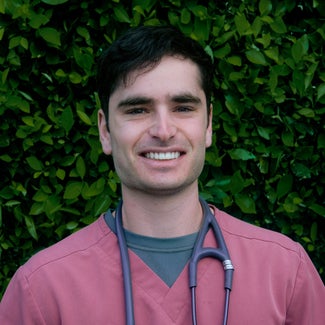
Associate Veterinarian
Hello, I am Dr. Harrison Saling! I'm an associate veterinarian here at Santa Monica Pet Medical Center. I went to Cal Poly San Luis Obispo, or Cal Poly SLO for short, for my undergraduate degree. I went four years there and got my bachelor's degree in animal science. Then, luckily, I got into vet school right after finishing college and didn't take any breaks; I just went straight into veterinary school after that.
My veterinary school was at St. George's University, which is actually in the Caribbean. It's on an island called Grenada. I had a great time there! Another 4-year program. Unfortunately, we started right during COVID-19. Our first year was actually online, but we eventually spent a total of three years on the island. As part of the program, they send you to a teaching hospital elsewhere. I completed my fourth year at The Ohio State University College of Veterinary Medicine.
After college, I worked as a small-animal veterinarian in Culver City for about a year and a half, and joined Santa Monica Pet Medical Center in March of 2026.
What do you like to do for fun when you're not at work?
I have a couple of hobbies I like. The one that is most recent, and I probably do most regularly, is calisthenics. Living in Santa Monica, we're very lucky that we can be outside and go to the beach over 300 days a year. I do like to do that on a regular basis. I have a group of friends and a nice community at Muscle Beach here in Santa Monica to work out, stay active, and get out in the sun.
I also love music just in general, particularly electronic music nowadays, but really all genres. I love a good concert, and a music festival is the best way to get the most bang for your buck because you see a bunch of different sets at once. I really like that. Another recent hobby that I just took on is snowboarding. Obviously, we're lucky in California to have Mammoth Mountain and Big Bear Mountain so close! I've gone to Mammoth a couple of times and once to Vermont as well. I'm trying to get good at snowboarding.
Dr. Saling Speaks About Pet Heart Disease and Murmurs
A topic I wanted to address in veterinary medicine is heart disease and heart murmurs in pets. It's a little bit different in dogs and cats. Dogs can get a variety of different heart diseases. Particularly in small dogs, the most common heart disease is a disease called mitral valve disease. It is a degenerative disease, meaning that it happens over time as the pet ages. That can result in a murmur sound that we hear when we listen with our stethoscope on exam. The importance of identifying murmurs early is crucial because there are certain medications that might be necessary, and also the presence of heart disease can impact things that we do in the future such as anesthetic procedures, surgeries, dentals, and things like that. Whenever I hear a murmur in a patient, I do recommend an echocardiogram as a next step to further evaluate that. It's a really non-invasive procedure that's done by a cardiologist. It's just an ultrasound of the heart. They are able to look at all the structures in much more detail, determine if there are medications that are necessary, and if a patient is a good candidate for anesthesia. It's good to not only catch those things early and treat when necessary, but also make sure that the patient is as safe as possible for those procedures.
Mitral valve disease is the most common heart disease in dogs, but they can get other diseases as well. There can be congenital diseases that dogs are actually born with. That's less common, but it's possible. An echocardiogram is a great tool for identifying those pathologies.
For cats, it's a little bit different. Cats can get a heart disease called hypertrophic cardiomyopathy. It works a little bit differently than mitral valve disease in dogs, but it can still result in a murmur sound. In cats as well, I do recommend an echocardiogram whenever I hear a murmur for the same reasons: to identify changes and determine if medications are necessary. Because cats are really good at hiding diseases and illness, we really try to push for an echocardiogram. There are some cats that have a very soft murmur or even no murmur at all, and have what we call occult heart disease, meaning hidden. This is why, regardless, if we do hear a murmur, it's important to further evaluate it.
Dogs and cats can also get what we call stress or physiologic murmurs, where just being stressed in the hospital causes increased blood flow through the heart, and that can cause the murmur sound, which is obviously the best-case scenario. In that case, there's nothing actually wrong with the heart. It's just that increased blood flow that we're hearing. But without an echocardiogram, it's hard to tell if that's actually the case.
If you live in or near Santa Monica, CA, and are looking for quality pet care, contact us at (310) 393-8218 to schedule an appointment. Our staff would love to talk with you!